NCERT · Exploring Society: India and Beyond · Part 1
🌤 Weather and its Elements
NCERT · Exploring Society: India and Beyond · Part 1 · Chapter 2
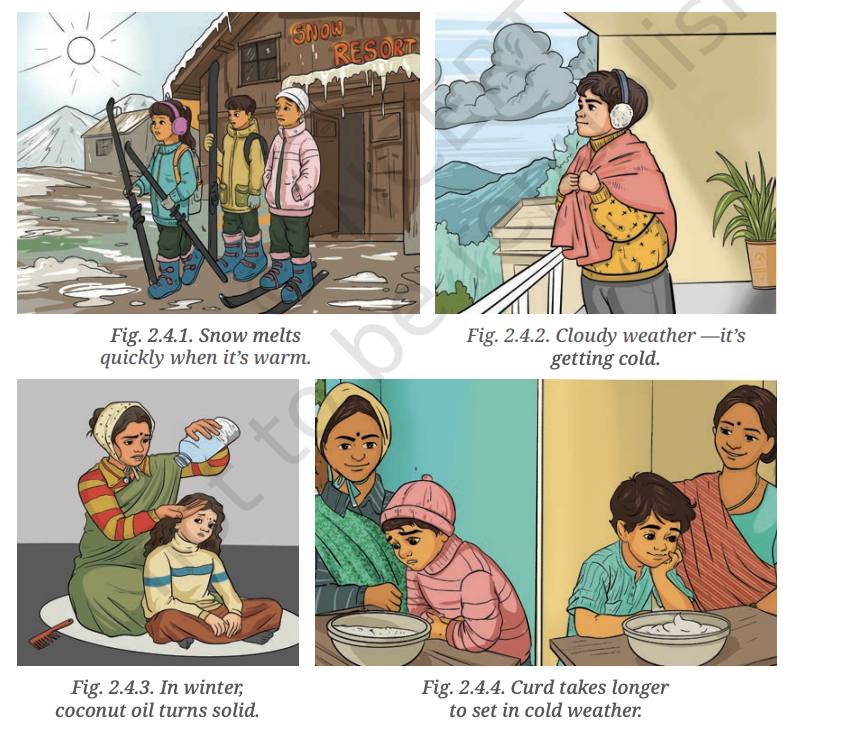
You wake up one winter morning and shiver. You reach for thick clothes to keep yourself warm. In the summer, you choose clothes that keep you cool and comfortable. You are responding to your body's signals; your body is sensing the weather.
🌍 What is Weather?
Weather is a state of the Earth's atmosphere at a particular time and place. The atmosphere is the layer of gases that surround some planets — in the case of our Earth, we call these gases 'air'.
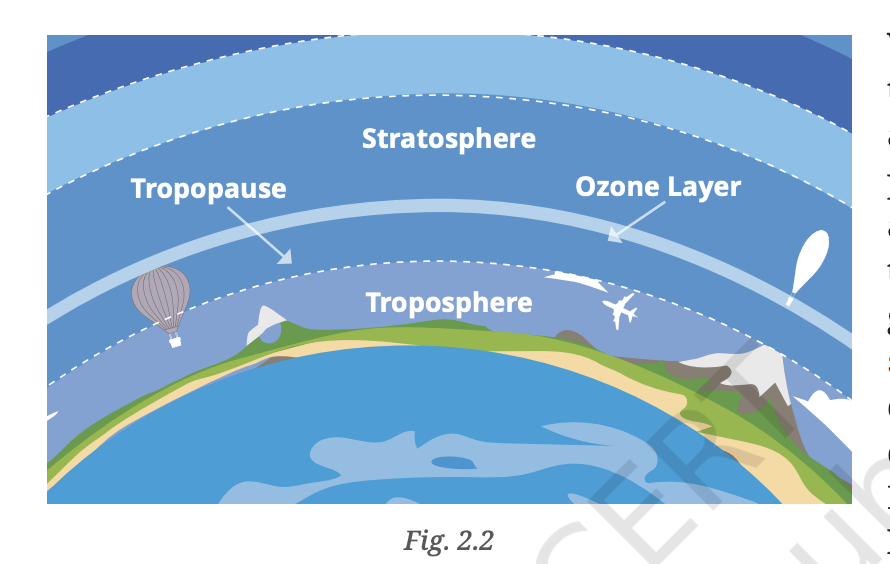
The Earth's atmosphere may be compared to a cake with several layers. The layer closest to the surface is called the troposphere — that is where all land-based plants and animals (including humans!) live and breathe. It is also where almost all weather phenomena take place.
Fig. 2.1 — Layers of the Earth's atmosphere; the troposphere is closest to the surface
The troposphere extends to a height of 6 to 18 kilometres from the ground. It is less thick at the poles (cold air contracts) and thicker in the tropical zone (warmer air expands).
🌡 Elements of Weather
Five measurable components that describe the weather
We use many words to describe the weather — hot, cold, rainy, cloudy, humid, snowy, windy. They describe the different ways in which we experience the elements of weather.
🌡
Temperature
How hot or cold the atmosphere is
🌧
Precipitation
Any form of water (rain, snow, sleet, hail) that falls from the sky
⚖
Atmospheric Pressure
The weight of the air above us, felt on the Earth's surface
💨
Wind
The movement of air, including its speed and direction
💧
Humidity
The amount of water vapour in the air
🤔 Think About It — Krishnan & Amir
Krishnan from Chennai is speaking with Amir in Kashmir. Krishnan says it has become chilly after the previous night's rain. Amir asks how cold it is. How will Krishnan explain to Amir how cold it is? After all, what is cold for Krishnan may be quite pleasant for Amir!
It would be difficult to convey the sense of chillness unless there is a commonly agreed way to measure the temperature. It is the same with all other elements of the weather. That is why we measure the weather using common standards.
🔍 Let's Explore
What do you think could be some other reasons to measure the weather more precisely? (Hint: Think how knowing the weather a few hours or a few days in advance would help you plan some activities.)
📖 Glossary
Sleet: Frozen or partly frozen rain.
Hail: Small, hard balls of ice that fall from the sky like rain.
Water vapour: Water in gaseous instead of liquid form.
Forecast: To predict or find out in advance (in our case, the weather).
🐜 Traditional Weather Forecasting
Ancient signs that humans have used to predict the weather
From early times, humans have closely observed Nature and learnt to read her signals to forecast the weather. Even today, in many parts of India, people use traditional ways to predict the weather, especially the arrival of the monsoon.
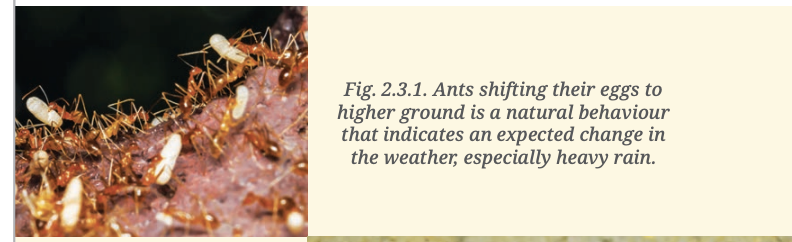
Fig. 2.3.1 — Ants shifting eggs to higher ground indicates expected heavy rain
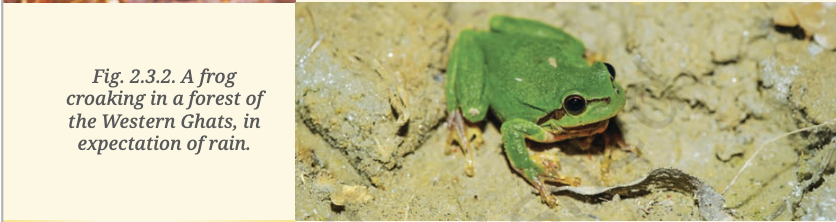
Fig. 2.3.2 — A frog croaking in the Western Ghats, in expectation of rain
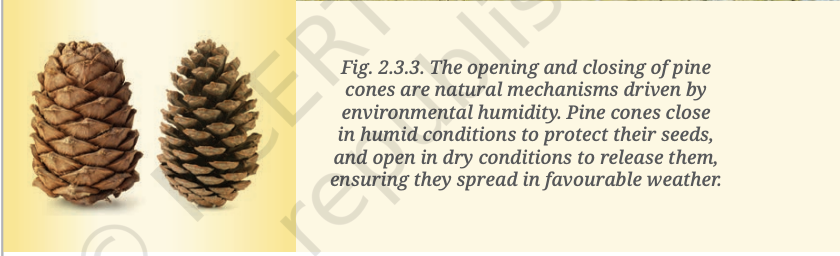
Fig. 2.3.3 — Pine cones close in humid conditions, open in dry conditions
Birds flying low
Ants carrying their eggs to higher ground
Squirrels gathering nuts
Frogs croaking loudly
Opening and closing of pine cones
This knowledge has been passed down from generation to generation. In the last few centuries, scientists have worked out methods to measure and monitor the elements of weather with great precision. Based on those inputs, meteorologists try to predict weather behaviour.
📚 Meteorology
Meteorology is the systematic study of weather and its evolution. This study is the basis for weather forecasting.
🔍 Let's Explore
Talk to elders in your neighbourhood and ask them how they predict the weather. What signs do they observe? Document any sayings in your regional language that refer to weather prediction.
🔭 Weather Instruments
How we measure each element of the weather precisely
There are several types of thermometers. Some measure the ambient temperature; others record the maximum and minimum temperatures during a day. Thermometers often use a coloured liquid which expands when temperature increases. Digital thermometers are preferred as they are more precise and can record more data.
Let's Explore — Temperature chart of a city in Madhya Pradesh: find maximum, minimum, and calculate the range
📊 Range of Temperature
= Maximum temperature − Minimum temperature (usually over 24 hours)
📊 Mean Daily Temperature
= (Maximum temperature + Minimum temperature) ÷ 2
🏛 Don't Miss Out — The India Meteorological Department (IMD) was set up in 1875. Its motto is ādityāt jāyate vriṣhti, which means "From the sun arises rain." The phrase comes from the ancient text Manusmṛiti. The complete sentence reads: "From the sun arises rain, from rain comes food, and from food, living beings originate."
🌧 b) Precipitation — Rain Gauge
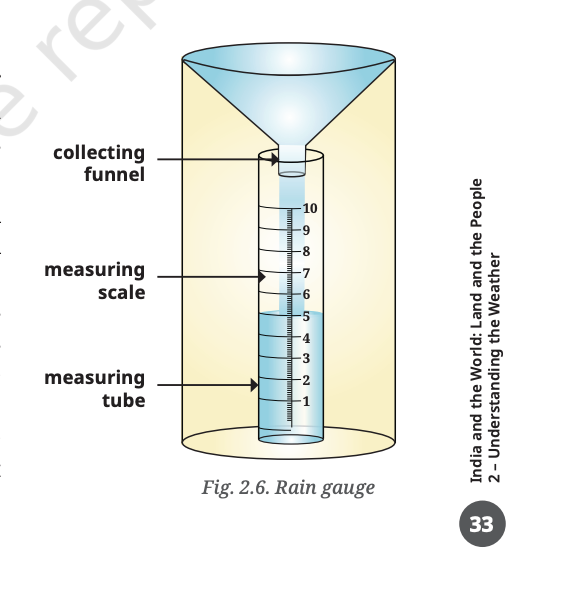
The amount of rainfall is measured with the help of an instrument called a rain gauge (Fig. 2.6). When it rains, the water falls into a funnel and is collected in a cylinder. A scale is attached to the cylinder to measure the depth of rainwater collected. When the height of water is 5 mm, we say that the area received 5 mm of rainfall.
Fig. 2.6 — Rain gauge: water falls into funnel, collects in cylinder; rainfall measured in mm
⚖ c) Atmospheric Pressure — Barometer
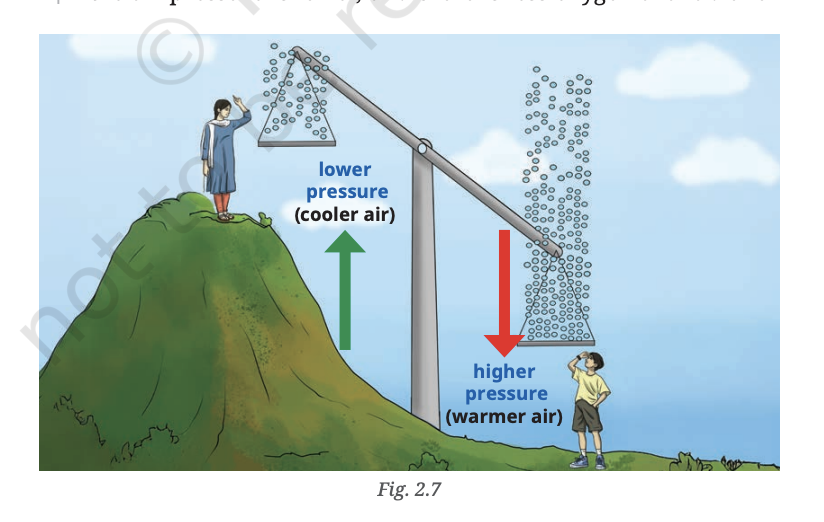
You may have experienced that the weather sometimes feels 'heavy', as before a thunderstorm. This is related to atmospheric pressure — the pressure exerted by the weight of the air above and around us.
Fig. 2.7 — Atmospheric pressure is higher near sea level and decreases with altitude; less oxygen at high altitude causes breathlessness
⛰ Pressure is higher near sea coast and lower at high altitude. Thinner air → less oxygen → breathlessness, dizziness, tiredness at high altitudes.
🤔 Think About It: Our army personnel serve at Khardung La in Ladakh (over 5600 metres above sea level). The atmospheric pressure there is generally about 650 millibars! People journeying to high altitudes are advised to make pauses to allow the body to acclimatise.
Atmospheric pressure sometimes drops dramatically, resulting in what meteorologists call a 'depression' or 'low-pressure system', which can develop into a storm or even a cyclone.
💨 d) Wind — Wind Vane & Anemometer
Wind is the movement of air from areas of high pressure to areas of low pressure. Speed and direction are two important factors when we describe the wind.
Fig. 2.9 — Wind-dispersed seeds: What would happen to these seeds if there was no wind?
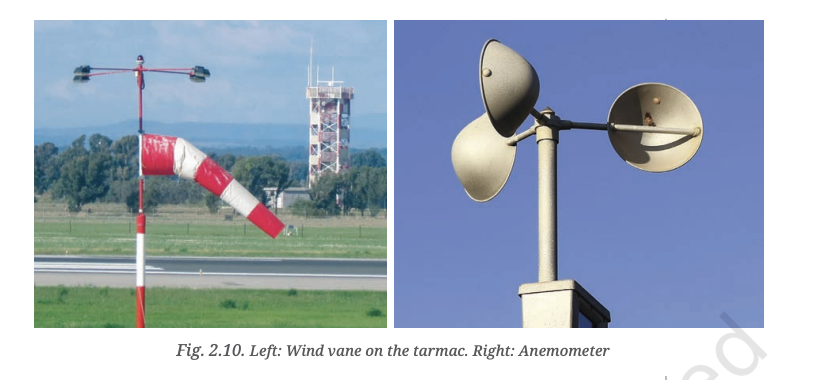
Fig. 2.10 — Wind vane / weather vane and wind sock on airport tarmac
🪄 Wind Vane
Rotating arm with a pointer and a tail. Wind pushes the tail → pointer turns in the direction of wind. A wind sock on airport tarmac gives pilots wind direction during take-off and landing.
💨 Anemometer
Three or four metal cups rotate on a vertical shaft. Stronger wind = faster rotation. Meter calculates wind speed in km/h.
Wind data is used by: Air pilots (flying), Sailors (navigation), Farmers (predicting rain direction), soil drying rate monitoring.
💧 e) Humidity — Hygrometer
Humidity is the amount of water vapour present in the air. It also depends on factors like temperature, wind, pressure and location.
🤔 Where is humidity likely to be more — Kochi or Jaipur? Kochi is near the sea, so it has higher humidity. The instrument that measures humidity is called a Hygrometer.
📡 Weather Stations
Where all weather instruments come together
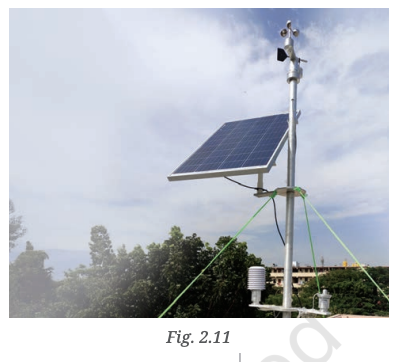
We need several instruments to measure the weather at a particular place and time. A weather station brings all these instruments together, making it easy to measure and track the weather. Readings are taken at regular intervals, which helps in mapping and forecasting the weather.
Fig. 2.11 — An Automated Weather Station (AWS)
⚙ Automated Weather Station (AWS)
An AWS is a self-operating system that uses various sensors to measure and record weather data — temperature, humidity, wind speed and direction, precipitation, and atmospheric pressure. Used in agriculture, aviation, navigation, and environmental monitoring, providing accurate and timely weather information without the need for human intervention.
🗺 Predicting the Weather
How meteorologists use data to forecast weather and save lives
Meteorologists collect data using instruments over long periods of time. They study the data and use scientific methods to predict how the weather will behave in a particular region — after a few hours, a few days, or even a few weeks.
Accurate predictions help us be ready for events and enable local governments to mobilise resources. For example:
If stormy weather is expected at sea, fishermen are warned about venturing out in their boats.
An entire coastal area might have to be evacuated if a cyclone is expected.
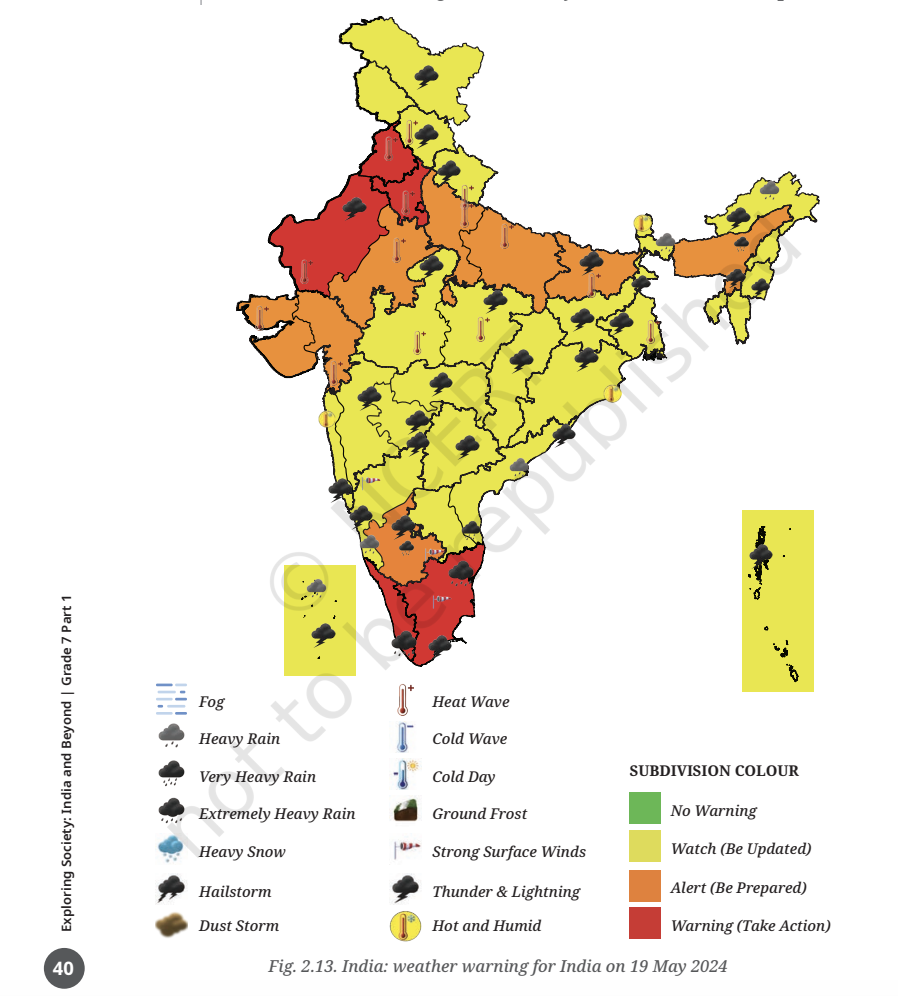
🗺 IMD Weather Map — 19 May 2024
Fig. 2.12 — Weather warning map issued by IMD on 19 May 2024
🔍 Let's Explore — Study the IMD map above and answer:
What do you observe happening on that day? What weather conditions is IMD alerting people to?
Which states have warning signs?
Which parts of India are likely to be free from severe weather?
Which states are likely to face heat wave conditions?
What are the causes for warning in Tripura and Lakshadweep?
🔍 Let's Explore — Discuss, in pairs, different situations in which weather predictions are helpful. Make a list, share and compare with the pair next to you. How many different categories have you identified?
📌 Before We Move On
Temperature, humidity, precipitation, wind and atmospheric pressure together define the weather at a particular place.
The condition of these elements is measured using special instruments. Data collected from these help us to monitor and predict the weather.
In different times or situations, one element is dominant — rainfall in July, temperature in May and December, atmospheric pressure when a cyclone is moving, and wind when a loo (hot, dusty winds in north India in summers) is blowing or forest fires are spreading.
Weather is closely linked to climate. We will discuss this in the next chapter.
✏ MCQ Practice — 15 Questions
Click an option to check your answer instantly!
Q1
The instrument used to measure temperature is ___
✅ Thermometer measures temperature in degrees Celsius (°C) or Fahrenheit (°F).
Q2
The unit used to measure rainfall is ___
✅ Rainfall is measured in millimetres (mm) using a rain gauge.
Q3
Weather is the condition of the atmosphere at ___
✅ Weather is the condition of the atmosphere at a specific place at a specific time.
Q4
Wind direction is measured by ___
✅ Wind vane points toward the direction from which wind blows. Anemometer measures wind speed.
Q5
Humidity in the air is measured by ___
✅ Hygrometer measures relative humidity as a percentage (%). Hair hygrometer uses human hair.
Q6
The India Meteorological Department (IMD) was established in ___
✅ IMD was established in 1875. It is headquartered in New Delhi.
Q7
Which cloud type brings heavy rainfall and thunderstorms?
✅ Cumulonimbus (type of nimbus cloud) brings heavy rain, thunderstorms and lightning.
Q8
A weather forecast covering 1–3 days is called ___
✅ Short-range forecast covers 1–3 days and is used for daily planning and agriculture.
Q9
The lowest temperature of the day usually occurs ___
✅ Temperature is lowest just before sunrise because the ground has radiated heat all night.
Q10
The average weather of a large area over 30+ years is called ___
✅ Climate is the average weather condition of a large area studied over 30 or more years.
Q11
The Southwest Monsoon season in India lasts from ___
✅ Southwest Monsoon: June to September — India's main rainy season (75% of annual rainfall).
Q12
Sea breeze blows from sea to land during ___
✅ Sea breeze blows during the day — land heats faster → hot air rises → cool sea air rushes in. Night: land breeze (opposite).
Q13
Which rainfall type occurs when moist air rises over mountains?
✅ Orographic (relief) rainfall — moist air hits a mountain, rises, cools and rains on the windward side. Leeward side stays dry (rain shadow).
Q14
The "Loo" is a type of ___
✅ Loo is a hot, dry dusty wind blowing in north India during May–June. Temperatures can reach 45–48°C.
Q15
A radiosonde is attached to a ___ to collect upper atmosphere data
✅ A radiosonde is an instrument package attached to a weather balloon that rises up to 30+ km and sends back temperature, humidity and pressure data.
📝 Questions & Answers
📖 NCERT Questions and Activities
Q1. Describe your experience of the weather today. Write down the elements of weather you observe. Activity
Answer (Sample): Today the weather is sunny and warm. The elements I observe are:
Temperature: Hot — approximately 34°C
Humidity: Moderate — sweat evaporates slowly
Wind: Light breeze blowing from the south-west
Precipitation: No rainfall; sky is clear
Atmospheric pressure: Normal; no heaviness felt
(Students should record their own observations on the day of the activity.)
Q2. What are some of the ways in which people have traditionally forecasted the weather? Find out from elders in your neighbourhood. Activity
Answer: Traditional weather forecasting methods include:
Birds flying low — rain expected soon
Ants carrying eggs to higher ground — heavy rainfall expected
Squirrels gathering nuts — cold winter ahead
Frogs croaking loudly — monsoon/rains approaching (common in Western Ghats)
Opening and closing of pine cones — pine cones close in humid conditions, open when dry
Many communities have sayings in regional languages about the sky colour, wind direction, or behaviour of animals that predict rain
(Students should interview elders and document local sayings.)
Q3. Make a table showing the elements of weather, the instrument used to measure them, and the unit of measurement. Activity
Answer:
Element of Weather
Instrument
Unit
Temperature
Thermometer
Degree Celsius (°C)
Precipitation (Rainfall)
Rain Gauge
Millimetres (mm)
Atmospheric Pressure
Barometer
Millibar (mb)
Wind Speed
Anemometer
km/h
Wind Direction
Wind Vane / Wind Sock
Cardinal direction (N, S, E, W)
Humidity
Hygrometer
Percentage (%)
Q4. Study the IMD weather warning map (Fig. 2.12). Answer the following: (a) What weather conditions does the map show? (b) Which states have warnings? (c) What is the weather warning for Jammu & Kashmir? Activity
Answer (based on IMD map dated 19 May 2024):
(a) Weather conditions shown: The map shows various weather warnings issued by IMD for different states — including heat wave conditions, thunderstorms, strong winds, and heavy rainfall warnings across different regions of India.
(b) States with warnings: Multiple states have warning signs shown on the map. States in the north-west (Rajasthan, Punjab, Haryana) likely have heat wave warnings. North-eastern states (Tripura, Meghalaya) and Lakshadweep likely have warnings for heavy rainfall or strong winds.
(c) Jammu & Kashmir: J&K may show warnings related to thunderstorms or strong winds, which are common in the region during this time of year due to western disturbances.
(Students should refer to the actual map in Fig. 2.12 / Fig. 2.13 in their textbook to give precise state-by-state answers.)
✏ 1 Mark Questions
Q1. Define weather. 1M
Answer: Weather is the condition of the atmosphere at a specific place at a specific time. It includes temperature, humidity, rainfall, wind speed and cloud cover.
Q2. What is a thermometer? 1M
Answer: A thermometer is an instrument used to measure temperature in degrees Celsius (°C) or Fahrenheit (°F).
Q3. Name the instrument that measures wind speed. 1M
Answer:Anemometer measures wind speed in km/h or m/s.
Q4. What is humidity? 1M
Answer: Humidity is the amount of water vapour present in the atmosphere. Relative humidity is expressed as a percentage (%).
Q5. What does IMD stand for? When was it established? 1M
Answer: IMD stands for India Meteorological Department. It was established in 1875 and is headquartered in New Delhi.
Q6. Define climate. 1M
Answer: Climate is the average weather condition of a large area studied over 30 or more years.
Q7. What is a rain gauge? 1M
Answer: A rain gauge is an instrument used to measure the amount of rainfall received at a place. Rainfall is measured in millimetres (mm).
Q8. Name the four types of clouds. 1M
Answer: The four types are: (1) Cirrus — high and feathery, (2) Cumulus — fluffy cotton-like, (3) Stratus — flat grey layers, (4) Nimbus/Cumulonimbus — dark rain-bearing clouds.
📘 2 Mark Questions
Q9. What is the difference between weather and climate? 2M
Answer: Weather is the short-term condition of the atmosphere at a specific place and time (changes daily). Climate is the average weather of a large area studied over 30+ years (relatively stable).
Example: "It is raining in Mumbai today" is weather. "Mumbai has a hot and humid climate" is climate.
Q10. What is humidity and how does it affect weather? 2M
Answer: Humidity is the amount of water vapour in the air, measured by a hygrometer in percentage (%).
High humidity makes weather feel hot and sticky; sweat does not evaporate easily
Low humidity makes air dry — causes thirst and cracked skin
When humid air cools → water vapour condenses → clouds and rainfall form
Q11. What are sea breeze and land breeze? 2M
Answer: Sea Breeze (Day): Land heats faster than sea → hot air over land rises → cool air from sea moves to land → sea breeze blows from sea to land. Land Breeze (Night): Land cools faster → sea stays warmer → air over sea rises → cool air from land moves to sea → land breeze blows from land to sea.
Q12. Name any two types of rainfall and explain them. 2M
Answer: 1. Orographic (Relief) Rainfall: Moist winds hit a mountain, rise, cool, condense and rain on the windward side. The leeward side is dry (rain shadow area). E.g., Western Ghats. 2. Convectional Rainfall: Land heats up → hot air rises rapidly → cools → heavy rainfall with thunder and lightning. Common in tropical regions in the afternoon.
Q13. What is maximum and minimum temperature? 2M
Answer: Maximum temperature: The highest temperature recorded in a day, usually occurring around 2–3 PM when the sun's heat has built up. Minimum temperature: The lowest temperature of the day, occurring just before sunrise when the earth has radiated maximum heat overnight.
A maximum-minimum thermometer records both values automatically.
Q14. What are the four seasons of India? (name and months only) 2M
Answer:
Winter Season — December to February
Summer Season — March to May
Southwest Monsoon — June to September
Retreating Monsoon — October to November
📗 3 Mark Questions
Q15. Describe any three weather instruments and their uses. 3M
Answer:
Thermometer: Measures temperature in °C or °F. A glass tube with mercury or alcohol expands when hot. Maximum-minimum thermometer records the daily range.
Anemometer: Measures wind speed in km/h or m/s. It has three or four rotating cups — faster rotation means stronger wind.
Rain Gauge: Measures amount of rainfall in millimetres (mm). It collects rainwater in a funnel-shaped container; the water is measured in a graduated cylinder.
Hygrometer: Measures relative humidity (%) in the air. The hair hygrometer works on the principle that human hair lengthens when humidity increases.
(Any three of the above with proper explanation)
Q16. Explain the role of the India Meteorological Department (IMD). 3M
Answer: The India Meteorological Department (IMD), established in 1875, is the government agency responsible for weather services in India.
Data Collection: Gathers weather data from hundreds of weather stations, ships, weather balloons, satellites and ocean buoys across India
Weather Forecasting: Issues short-range (1–3 days), medium-range (3–10 days) and long-range (seasonal) forecasts for the public, farmers, aviation and navy
Cyclone Warning: Provides advance warnings for cyclones, floods and droughts to save lives and property
Monsoon Monitoring: Tracks onset, progress and withdrawal of the monsoon every year, vital for agriculture
Research: Conducts climate research and maintains historical weather records
Q17. Describe the southwest monsoon season in India. 3M
Answer: The Southwest Monsoon season lasts from June to September and is the most important season for India.
Origin: Winds blow from the Indian Ocean (southwest direction) loaded with moisture
Rainfall: India receives about 75% of its annual rainfall during this season
Two branches: (a) Arabian Sea branch — hits Western Ghats, brings heavy rain to west coast; (b) Bay of Bengal branch — moves north, brings rain to northeast and then across the Gangetic plains
Agriculture: Most of India's kharif crops (rice, maize, cotton) depend on monsoon rainfall
Onset: Monsoon reaches Kerala around June 1 and gradually advances northward
Q18. How do clouds form and bring rainfall? Explain the water cycle concept. 3M
Answer:
The sun heats surface water (oceans, rivers, lakes) → evaporation occurs — water turns to water vapour
Warm, moist air is lighter → it rises into the atmosphere
As air rises, it cools down (temperature drops with altitude)
Cool air cannot hold as much water vapour → condensation occurs — tiny water droplets form around dust particles
Millions of droplets together form a cloud
Droplets combine and grow larger → too heavy to stay in air → fall as rain, snow or hail
Water returns to the earth → flows back to rivers and oceans → water cycle continues
Q19. Distinguish between weather and climate with examples from India. 3M
Answer:
Weather
Climate
Short-term (hours/days)
Long-term (30+ years)
Changes frequently
Relatively stable
Specific place and time
Large region
E.g.: "Delhi had heavy rain today"
E.g.: "Delhi has a semi-arid climate with hot summers"
India has diverse climates: tropical monsoon in most parts, alpine in the Himalayas, arid in Rajasthan, and equatorial in Andaman Islands.
📕 5 Mark Questions
Q20. Describe all the elements of weather and the instruments used to measure them. 5M
Answer: The main elements of weather are:
1. Temperature: The degree of hotness or coldness of the air. Measured by a thermometer in °C or °F. It is highest at 2–3 PM and lowest just before sunrise. A maximum-minimum thermometer records both.
2. Humidity: The amount of water vapour in the air. Measured by a hygrometer as relative humidity (%). High humidity makes weather feel muggy and uncomfortable. At 100% humidity, condensation occurs.
3. Rainfall/Precipitation: Water falling from clouds as rain, snow or hail. Rainfall measured in millimetres (mm) by a rain gauge. Types: orographic, convectional and cyclonic rainfall.
4. Wind: The horizontal movement of air. Wind speed measured by an anemometer (km/h). Wind direction by a wind vane (N, S, E, W). Caused by differences in air pressure.
5. Cloud Cover: The proportion of sky covered by clouds. Measured in oktas (0–8). Cloud types include cirrus, cumulus, stratus and nimbus.
6. Air Pressure: The weight of air above a point. Measured by a barometer in hPa. Falling pressure indicates approaching storms.
All these elements are recorded at weather stations set up across the country and compiled by the India Meteorological Department (IMD).
Q21. Explain the four seasons of India in detail. How does each season affect the life of people? 5M
Answer:
1. Winter Season (December–February): Cold and dry. Northeastern winds blow. Temperature drops to 5°C or below in north India. Western disturbances bring snow to Himalayas and rain to northwest plains. People wear warm clothes; rabi crops (wheat, mustard) are grown.
2. Summer Season (March–May): Hot and dry. Temperature can reach 45–48°C in Rajasthan. The "Loo" — a hot, dry wind — causes heat strokes. Dust storms (andhis) occur. People prefer light cotton clothes; water scarcity increases.
3. Southwest Monsoon Season (June–September): Hot and wet. Moisture-laden winds from the Indian Ocean bring 75% of India's annual rainfall. Kharif crops (rice, cotton, pulses) are sown. Rivers flood; dams fill. Humidity is very high, making weather uncomfortable.
4. Retreating Monsoon / Post-Monsoon (October–November): Southwest monsoon withdraws from northwest India. Northeast winds bring rainfall to the Coromandel Coast (Tamil Nadu). Weather becomes pleasant. Rabi crops are sown as winter approaches.
The seasons significantly affect farming, transport, tourism, water supply, clothing and daily routines of millions of people across India.
Q22. Explain the importance of weather forecasting. How does IMD collect and process weather data? 5M
Answer:Importance of Weather Forecasting:
Agriculture: Farmers plan sowing, irrigation, harvesting and use of pesticides based on forecasts
Aviation: Pilots check weather forecasts for turbulence, fog, storms and wind patterns before flights
Shipping and Fishing: Sailors and fishermen need warnings about storms and cyclones at sea
Disaster Management: Early warnings for cyclones, floods and droughts help authorities evacuate people and save lives
Daily Life: People plan travel, events and clothing based on weather forecasts
How IMD Collects Data:
Weather Stations: Over 700 surface observatories across India record temperature, rainfall, humidity and wind every 3 hours
Weather Balloons (Radiosonde): Launched twice daily, they carry instruments to heights of 30+ km and transmit data on temperature, humidity and pressure in the upper atmosphere
Satellites: Indian satellites (INSAT) take images of cloud cover, cyclones and storm systems every 30 minutes
Doppler Radar: Detects precipitation and wind patterns within 400 km radius
Ocean Buoys and Ships: Measure sea surface temperature, wave height and wind over the oceans
Computer Models: All data is fed into supercomputers that run numerical weather prediction models to generate forecasts for 1 to 15 days
Q23. (NCERT) What are the different elements that make up weather? Describe each. 5M
Answer: The six main elements of weather are:
Temperature — tells how hot or cold the air is. Measured in °C by a thermometer. High temperature = summer; low = winter.
Humidity — the water vapour content of air. Measured by hygrometer in %. High humidity = muggy and uncomfortable; causes clouds and rain.
Rainfall — water falling from clouds. Measured by rain gauge in mm. Essential for agriculture and freshwater supply.
Wind — movement of air from high to low pressure areas. Speed measured by anemometer; direction by wind vane. Strong winds can cause storms and damage.
Cloud Cover — proportion of sky covered by clouds (0–8 oktas). Clouds are formed by condensation of water vapour. Cloud type indicates likely rainfall.
Air Pressure — measured by barometer. Low pressure = stormy weather; high pressure = clear weather. Winds blow from high to low pressure areas.
All these elements change from place to place and time to time, making each day's weather unique.
Q24. How does weather affect the daily life of people in India? Give examples. 5M
Answer: Weather has a profound impact on every aspect of daily life in India:
Clothing: People wear woollens in winter, light cottons in summer. Umbrellas and raincoats are used in monsoon.
Food: Hot soups and tea in winter; cold drinks and light food in summer. Availability of seasonal fruits and vegetables changes.
Agriculture: Farmers sow rabi crops (wheat) in winter and kharif crops (rice) in monsoon. Drought ruins crops; excessive rain causes floods.
Transport: Fog in winter causes flight delays and road accidents. Cyclones and storms disrupt sea transport. Floods block roads and railways.
Health: Cold waves cause pneumonia; heat waves cause dehydration and heat stroke. Monsoon increases mosquito-borne diseases like malaria and dengue.
Energy: Cold weather increases demand for heating fuels. Hot weather increases electricity demand for cooling. Monsoon fills reservoirs for hydroelectric power.
Tourism: Hill stations attract tourists in summer to escape heat. Coastal areas are popular in winter. Monsoon reduces tourism due to heavy rains.
Thus, understanding weather helps people adapt, plan and manage their daily activities efficiently.
📌 Quick Revision Summary
Weather = condition of atmosphere at a specific place and time
Six elements: temperature, humidity, rainfall, wind, cloud cover, air pressure
Thermometer → °C | Rain gauge → mm | Anemometer → km/h | Wind vane → direction | Hygrometer → %